
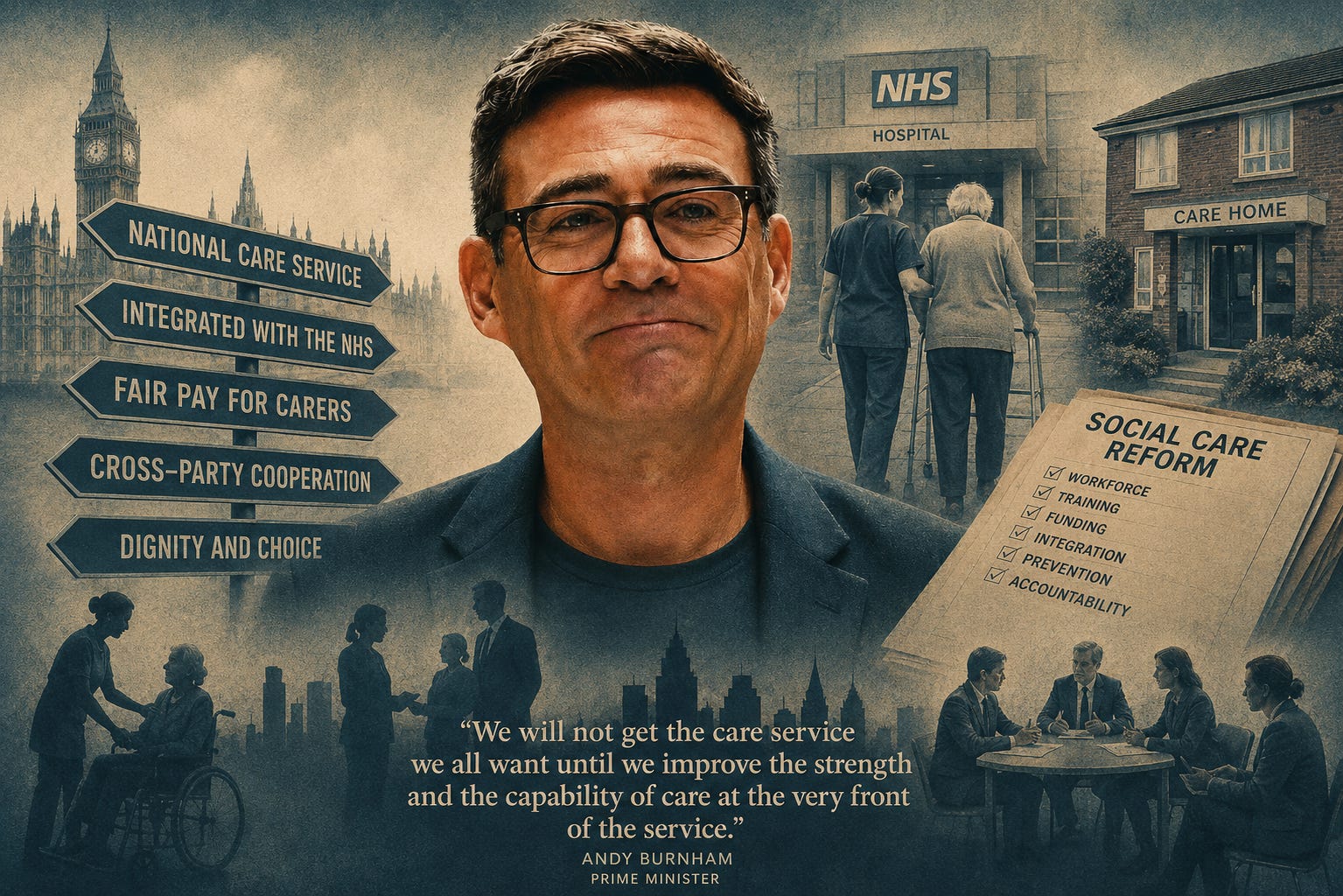
For almost three decades, social care has been the issue Westminster has preferred to postpone.
Governments have commissioned reviews. Opposition parties have made promises. White papers have gathered dust. Meanwhile, demand has grown, the workforce has remained under pressure and families have continued to shoulder an increasing burden.
Andy Burnham’s speech marked a notable attempt to change that.
Rather than beginning with policy, statistics or party politics, the Prime Minister began with his father.
Speaking candidly about his family’s experience of the care system, Burnham praised the carers who had supported his father with professionalism, compassion and dignity. It was a reminder that while political debate often focuses on institutions, funding and reform, social care ultimately depends upon people.
His praise for care workers was one of the strongest moments of the speech.
Watching someone care for another person’s parent, he argued, reveals just how skilled the profession truly is. From helping someone move safely between a wheelchair and a bed to drawing out the personality of someone living with dementia through conversation, social care demands expertise that is too often overlooked.
His conclusion followed naturally.
They should be the best paid people in society, not the worst.
It is difficult to argue with the broader principle.
For years, successive governments have relied on a workforce expected to deliver increasingly complex care while often receiving relatively low pay, limited opportunities for progression and little public recognition. Burnham’s proposal to strengthen fair pay, improve training and create clearer career pathways represents a significant shift in how the profession is viewed.
Importantly, he spoke not simply about increasing salaries but about professionalising social care itself.
The ambition to create progression routes between social care and the NHS reflects a recognition that both sectors depend upon one another. A stronger workforce benefits not only care providers but the wider health service.
That connection formed the central argument of Burnham’s speech.
He rejected the idea that social care exists separately from the NHS.
Instead, he described two systems that have become inseparable.
Anyone working across health and care is unlikely to dispute that observation.
Delayed hospital discharges remain one of the clearest examples.
During my own five-week stay in hospital, I witnessed patients who had been declared medically fit for discharge remaining on wards because appropriate care packages had not been arranged. One individual had spent approximately eighteen months in hospital despite no longer requiring acute medical treatment.
The consequences were visible every day.
Hospital beds remained occupied by people who no longer needed hospital care, while NHS staff continued working under intense pressure and new patients waited for beds to become available.
This is precisely why greater integration between health and social care matters.
It is not simply about administrative efficiency.
It is about ensuring that when a patient is ready to leave hospital, the support they need is already in place.
Burnham’s proposal for a National Care Service sitting alongside the NHS therefore deserves serious consideration.
Whether that ultimately proves to be the right structural model remains open to debate. Questions about funding, governance and accountability are substantial and will inevitably dominate Baroness Casey’s review.
But the principle behind it is difficult to dismiss.
Britain cannot expect the NHS to operate efficiently while social care remains under-resourced and disconnected.
Burnham also made another observation that deserves attention beyond the immediate debate.
Asked about assisted dying, he argued that now is not the time to pursue that discussion while palliative care and social care remain under such strain.
His point was not that the debate should never happen.
Rather, he argued that society should first ensure people have access to high-quality care before considering questions about assisted dying.
Whatever one’s view of assisted dying itself, the sequencing is significant.
Public confidence in any future debate depends, in part, upon confidence that people are receiving the support they need to live with dignity.
That argument extends beyond end-of-life care.
If Britain wants more disabled people to enter employment, as governments of different political persuasions increasingly do, then social care must also enable that ambition.
Support should not be viewed merely as a safety net.
For many disabled people, it is the foundation that makes work, education, volunteering and community life possible.
There was, however, one notable omission from Burnham’s speech.
Its emotional centre was understandably his father and the experiences of older people receiving care.
Yet social care is not solely an issue of ageing.
It also shapes the lives of working-age disabled adults seeking independence, parents raising families while relying on personal assistance, young adults leaving education and individuals pursuing careers while managing long-term conditions.
These are not separate conversations.
They are part of the same system.
A National Care Service, if it is to emerge, must recognise both realities: supporting people in later life while also enabling disabled people of working age to live independently, participate fully and contribute to society.
Perhaps the most encouraging aspect of Burnham’s speech was not a specific policy announcement but its tone.
He acknowledged that politicians of his own generation had failed to resolve social care despite decades of reviews and promises.
He called for cross-party cooperation rather than point scoring.
Whether that aspiration survives the realities of Westminster remains uncertain.
Social care has defeated governments before.
The politics are difficult.
The funding questions are harder still.
Yet Burnham was right about one thing.
Britain can no longer pretend that social care is a peripheral issue.
It is central to the future of the NHS, to the resilience of families, to the dignity of older people and disabled people alike, and to the kind of society the country wishes to become.
After thirty years of delay, the question is no longer whether social care needs reform.
It is whether this political moment will finally deliver it.