
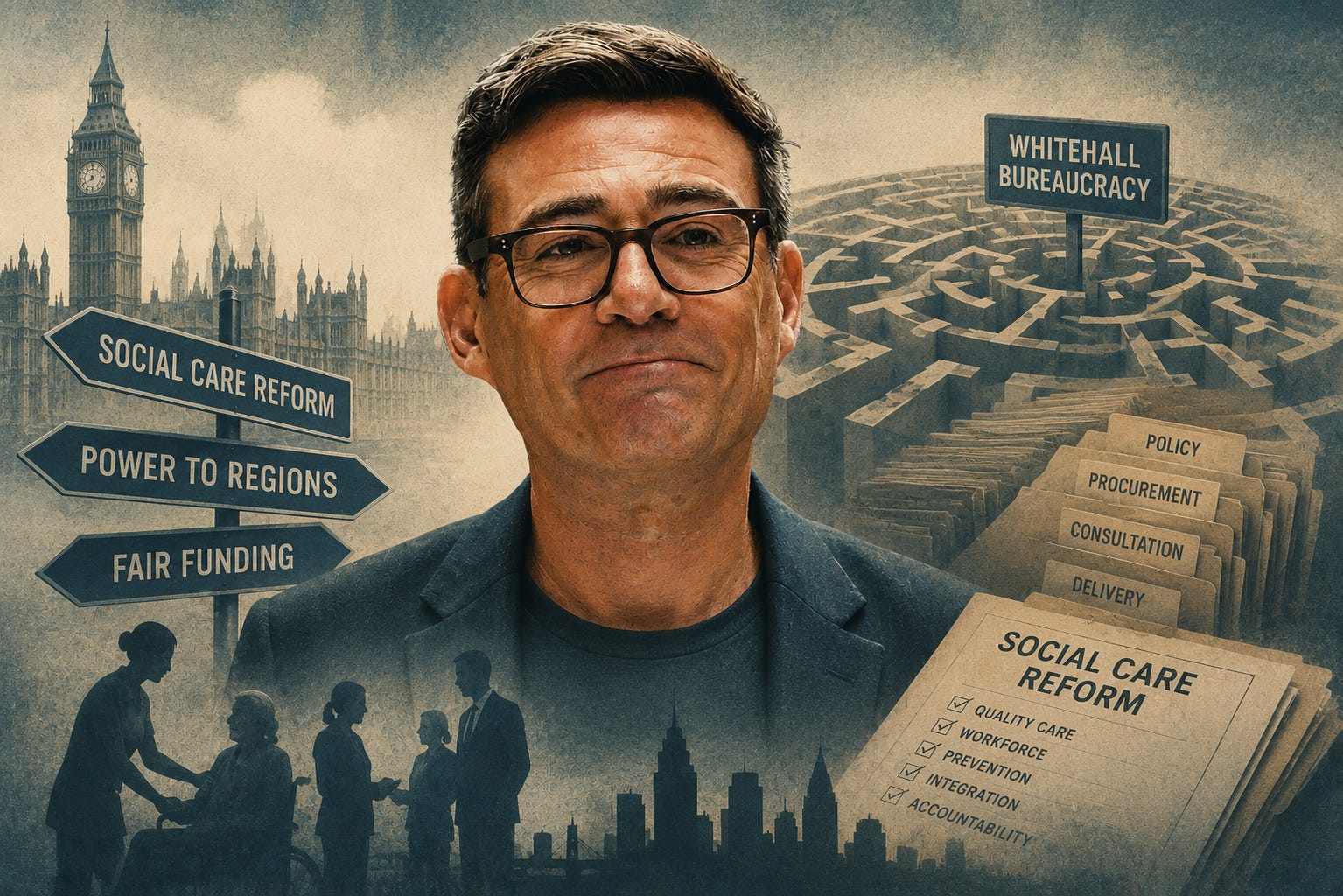
If Andy Burnham were to become Prime Minister, many within social care would welcome the possibility of a leader who understands public services, communities, and the challenges facing people who rely on support.
But there is a more difficult question: can a Prime Minister who wants to reshape social care overcome the very system they inherit?
Because the challenge facing social care is not only political. It is structural.
For decades, governments of different political colours have promised reform, yet many have struggled to deliver lasting change. Reports are written, consultations take place, strategies are launched — but on the ground, many disabled people, older people, families, and care workers continue to experience the same frustrations.
The Westminster machine has a reputation for absorbing ambition.
The gap between political vision and government delivery
One of Andy Burnham’s strengths has been his ability to operate outside the traditional Westminster bubble. As Mayor of Greater Manchester, he has promoted a model of local decision-making, partnership working, and bringing services closer to communities.
However, Downing Street operates differently.
A Prime Minister does not simply decide on a policy and see it implemented. Ideas must move through government departments, Treasury negotiations, parliamentary processes, regulatory frameworks, and civil service structures.
This can create a significant gap between what politicians want to achieve and what the machinery of government is capable of delivering.
Social care is particularly vulnerable to this because it sits across multiple systems: health, local government, employment, housing, benefits, and disability policy.
A reform agenda that looks simple politically can become incredibly complex administratively.
The civil service challenge
The civil service plays a vital role in government. It provides expertise, continuity, and institutional knowledge.
However, one criticism often made by reformers is that Whitehall can sometimes favour caution over transformation.
Large-scale change involves risk. It requires challenging existing assumptions and redesigning systems that have existed for decades.
For social care, this could mean moving away from a crisis-response model towards prevention, independence, and community support.
The question is whether the system is designed to enable that kind of change or whether it naturally pulls leaders back towards maintaining what already exists.
Will Whitehall understand social care differently?
One of the historic challenges for social care is that it has often struggled for political attention compared with the NHS.
The NHS has a powerful national identity. Social care is more fragmented, delivered through local authorities and independent providers, and often discussed through the language of budgets and eligibility rather than human lives.
A Prime Minister who genuinely understands social care would need to change that conversation.
The danger is that reform becomes another government programme rather than a cultural shift.
Social care cannot be transformed simply through legislation. It requires a different understanding of what care is for.
The Treasury question
Ultimately, every reform agenda meets the same department: the Treasury.
A more ambitious social care system requires investment. Better pay for care workers, stronger community services, improved support for disabled people, and greater choice all come with costs.
The argument, however, is that failing to invest also has a cost.
When people do not receive the right support, pressure increases on hospitals, families leave work to provide unpaid care, and people lose opportunities to contribute economically and socially.
The question is whether government sees social care as expenditure or as infrastructure.
Can Burnham change the culture of government?
The biggest test of a Burnham premiership may not be whether he has the right ideas.
It may be whether he can change the way government thinks.
The challenge is moving from a Westminster culture that often reacts to problems towards one that understands people’s lives before they reach crisis.
For social care, success would not simply be measured by a new bill passing through Parliament.
It would be measured by whether a disabled person has more choice, whether a family carer feels supported rather than abandoned, and whether a care worker feels valued rather than exhausted.
Andy Burnham may bring a different vision to Downing Street.
But the Westminster machine will decide whether that vision becomes reality — or whether it becomes another ambitious promise that slowly disappears into the corridors of Whitehall.
The future of social care may depend not only on who sits in the Prime Minister’s office, but on whether the system around them is willing to change.