
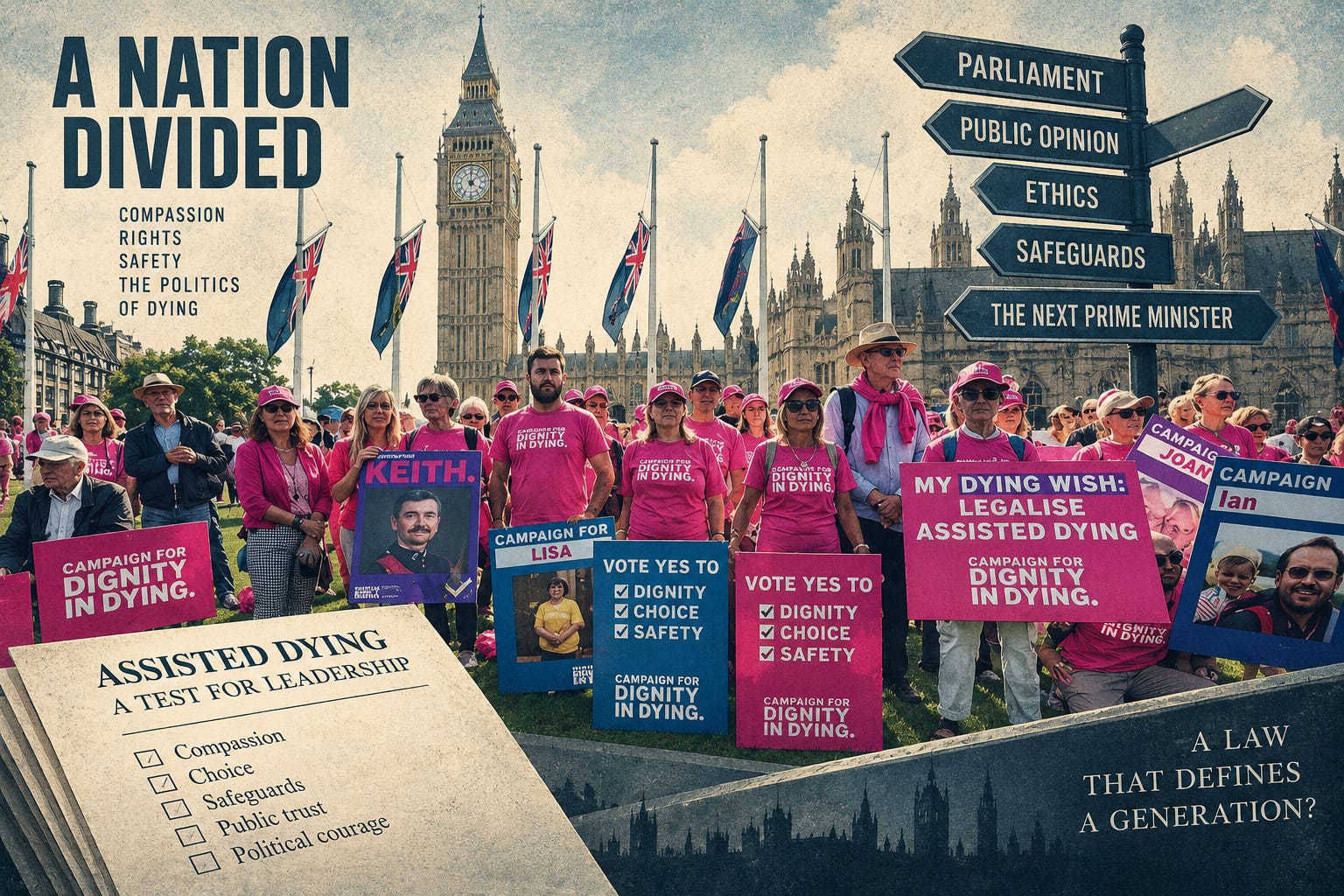
On Friday 11th September 2026, Members of Parliament gathered in the House of Commons to debate a subject that has been debated and, more importantly, voted down multiple times over the past decade. The question put to the House was: Do we allow adults who are terminally ill, subject to safeguards and protections, to request and be provided with assistance to end their own life?
The four-hour debate heard arguments on both sides. Members shared stories from their own experiences of seeing their loved ones die in the most horrifying circumstances. You can understand why they would vote for the bill. As each member stood up to share their reasons for voting for or against, it became unclear which side was ahead. Members from all sides of the House stood up and shared stories from their constituents, their concerns about the current bill, and how their stories had shaped their view on what has been described as one of the most controversial bills.
A brief history of assisted dying in the UK
1961: The Suicide Act
A crucial starting point is the Suicide Act 1961. It decriminalised the act of suicide in England and Wales, but assisting another person to die remained a criminal offence. That distinction is still fundamental to the modern debate.
2003: Lord Joffe’s first attempt
One of the significant modern parliamentary attempts came from Lord Joel Joffe, who introduced the Patient (Assisted Dying) Bill in the House of Lords in 2003. He subsequently introduced revised versions of the legislation, but none became law. This helped establish assisted dying as a serious parliamentary issue rather than something discussed only by campaign organisations.
2014: Lord Falconer’s Bill
Lord Charles Falconer introduced the Assisted Dying Bill in the House of Lords in 2014. It proposed allowing terminally ill, mentally competent adults with a prognosis of six months or less to request assistance to end their lives, subject to safeguards. The proposal became one of the most significant attempts to change the law at Westminster.
2015: A major Commons vote
The issue then reached the House of Commons in a particularly significant way.
Labour MP Rob Marris introduced the Assisted Dying (No. 2) Bill in 2015. MPs debated it for several hours before voting overwhelmingly against it:
330 MPs voted against the Bill, while 118 voted in favour.
That defeat effectively ended that particular parliamentary attempt.
2014–2021: The debate continued through the courts and public campaigns
Although Parliament had rejected attempts to change the law, the issue did not disappear.
Cases involving people who wanted assistance to die continued to reach the courts, including Tony Nicklinson and later Noel Conway. These cases raised difficult questions about individual autonomy, Article 8 rights, and whether Parliament, rather than the courts, should decide the issue.
Meanwhile, campaign organisations including Dignity in Dying continued campaigning for a change in the law.
2021: Jersey and the Isle of Man
The debate also began moving beyond Westminster. Jersey’s government agreed in principle to introduce assisted dying legislation, while the Isle of Man subsequently developed its own proposals.
That became important because supporters could increasingly point to developments elsewhere in the British Isles when arguing that assisted dying could operate within a regulated framework.
2022: Canada and other international examples
International developments also became increasingly important to the UK debate. Supporters pointed to countries such as Canada, Australia and New Zealand, while opponents highlighted concerns arising from jurisdictions where eligibility had subsequently expanded or where safeguards had been questioned.
That international evidence has become a major part of the argument on both sides.
2024: A new Bill
The issue returned to Parliament in a major way in 2024 when Labour MP Kim Leadbeater introduced the Terminally Ill Adults (End of Life) Bill.
Unlike some previous attempts, this was introduced as a Private Member’s Bill in the House of Commons rather than beginning in the Lords.
The Bill proposed allowing terminally ill adults who meet specified conditions to request assistance to end their life. It contained a series of eligibility requirements and safeguards.
29 November 2024: Commons second reading
MPs voted 330 to 275 in favour of the Bill’s second reading.
That was a dramatic change from the 2015 result. It meant the Bill would continue through Parliament for detailed scrutiny. However, after extensive scrutiny and amendments in the House of Lords, the Bill ran out of parliamentary time and ultimately failed to become law.
Why was this vote different?
In many ways, this bill was identical to the bill Kim Leadbeater brought to the House last year. Why did this matter? Because this was effectively a reintroduction of the Bill that had previously passed the Commons, there was a potential route for the Parliament Acts to be used if the Commons approved it again and the House of Lords subsequently failed to pass it. In other words, the Lords could potentially have been prevented from having the final say.
Since the original Bill was introduced, MPs had seen the Bill undergo enormous scrutiny in the Lords. More than 1,000 amendments were tabled, and concerns about safeguards, implementation and the potential impact on vulnerable people became increasingly prominent. Some MPs who supported the principle of assisted dying became less comfortable with this particular Bill.
Janet Daby, the Labour MP for Lewisham East, said she had previously voted for the bill, but said she “could not again in good conscience” vote for it now after having nightmares concerning “dying and death”.
Another very important thing to remember is that, in the last parliamentary year, we had a Prime Minister who supported assisted dying and voted for the Bill. This time, our new Prime Minister, Andy Burnham, chose to stay out of the debate and did not vote. He has said that before assisted dying is considered in England and Wales, the funding of palliative and social care should be "fixed". This short but impactful statement was echoed across the House.
Member of Parliament for South West Devon, Rebecca Smith MP, said:
Marie Curie reports that nearly one in three dying people have unmet palliative care needs. That is 200,000 people across the UK each year. Without improvement this is expected to rise to 250,000 by 2050.
Backlash from the Disability Community
Disability Rights UK argued that disabled people are already being made to feel like a burden and that they are not currently “assisted to live” adequately in the UK. It specifically raised concerns about access to housing, social care and palliative care.
“Disabled people aren’t currently assisted to live in the UK. Our rights are violated daily, our access to essential services is denied, and we are made to feel like a burden to society.”
It goes further, arguing that if the Bill became law;
“It would be easier in practice to access assisted dying than it would be to access adequate housing, social care and palliative care.”
That statement should make all of us stop and think.
Because I receive social care every single day. I know what it means to depend on other people to live the life I want to live. And that is why I have a concern that goes beyond the question of whether assisted dying should be legal. What happens when someone feels like a burden because the system designed to support them is failing?
Assist Us To Live put it even more bluntly following Friday’s vote:
“As disabled people, we fight every day just to get support to eat, wash, leave our homes, and work, while palliative and social care systems remain dangerously underfunded.”
So when we talk about giving vulnerable people a choice, I think we have to ask ourselves a much harder question:
Have we given them enough support to make sure that choosing to die isn’t simply a response to feeling like a burden?