
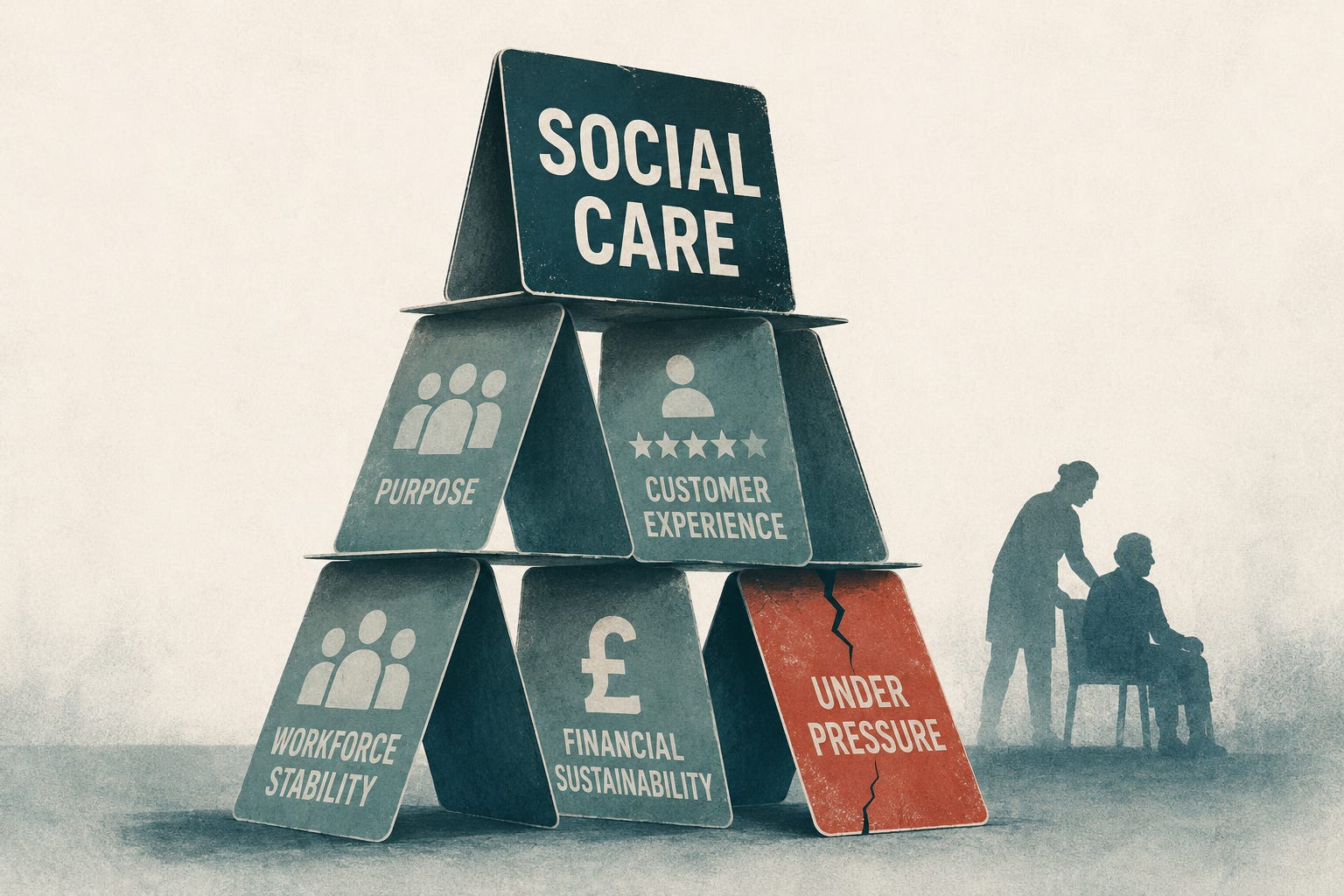
If social care were a listed company shareholders would be asking urgent questions and many would already be heading for the exit.
On any basic business test purpose customer experience workforce stability and financial health the sector would struggle to pass. Yet unlike a failing company it cannot collapse restructure or shut down. It simply absorbs pressure until something else breaks instead.
That is the uncomfortable reality we have normalised.
A system that no longer matches its own purpose
Social care is supposed to help people live with dignity independence and control over their lives. That is its founding promise.
But in reality the system has drifted towards something far narrower. Rationed support crisis intervention and eligibility management now define much of the experience. Care is increasingly shaped not by what improves someone’s life but by what can be afforded after competing pressures are taken into account.
The gap between stated purpose and lived experience is now hard to ignore.
If these were customers they would be leaving in droves
In any functioning market customer satisfaction would be a warning light.
Families struggle to navigate a system that feels fragmented and opaque. People wait too long for assessments. Choice is often limited in practice even when it exists in theory. Continuity of care is disrupted by constant turnover.
None of this is new. What is striking is how normal it has become.
Yes many people still describe excellent individual care workers. But that is precisely the point. The quality of human relationships persists in spite of the system not because of it.
A workforce stretched beyond recognition
No private company would tolerate staffing conditions like these.
Vacancy rates remain high. Turnover is chronic. Pay is low relative to responsibility. Progression is limited. The emotional burden is significant.
The sector survives because of the commitment of staff who routinely go beyond what they are paid or resourced to do. That goodwill is now effectively part of the operating model.
But goodwill is not a strategy.
Financially the model is already under water
The funding structure is equally fragile.
Local authorities are under relentless pressure. Providers operate on razor thin margins. Demand continues to rise year on year driven by demographic change and increasing complexity of need.
In any commercial environment this combination would trigger restructuring asset review or insolvency planning.
In social care it triggers another round of short term funding settlements and political reassurance that the system is stable.
It is not.
But unlike a company it cannot go bankrupt
Of course the analogy only goes so far.
A company in this position would fail. Social care cannot. It does not have the luxury of exit. The demand is not optional. People still need support to live age recover and manage disability regardless of whether the system is fit for purpose.
So instead of collapse we get something more corrosive. Managed deterioration.
The consequences are absorbed elsewhere by unpaid carers pushed to breaking point by NHS hospitals holding people who should not be there and by communities quietly filling the gaps.
A system sustained by obligation not design
The most honest description of social care today is not that it is failing outright.
It is that it is being sustained despite its failure.
It continues not because it is designed well funded properly or operating efficiently but because millions of people have no choice but to keep it going.
And that raises a question we keep avoiding.
If this were a business would anyone invest in it or would we finally admit the model itself needs rebuilding from the ground up?