
The publication of the Timms Review marks another pivotal moment in Britain’s long-running debate about disability, welfare and work. Ministers hope it will help shape a system that encourages more disabled people into employment while ensuring support reaches those who need it most. The review arrives against the backdrop of rising welfare expenditure, increasing pressure on public finances and growing political consensus that the current system is not sustainable.
Much of the debate has centred on Personal Independence Payment (PIP). Questions have been asked about eligibility, assessments, fraud, expenditure and the number of people claiming disability-related benefits. These are legitimate issues for any government responsible for managing the public purse.
Yet there is a danger that the conversation becomes consumed by the mechanics of welfare while overlooking a far more fundamental question.
What does it actually mean to live independently?
For decades, disability policy has often been framed around two competing ideas. On one side sits welfare dependency. On the other sits personal independence. The implication is that the more support someone receives, the less independent they become.
It is an attractive political narrative.
It is also, for many disabled people, profoundly mistaken.
The reality is that support and independence are not opposing forces. In many cases, one makes the other possible.
The Government has made clear that it wants more disabled people to enter employment. It is an ambition that deserves broad support. Work offers far more than a payslip. It provides routine, purpose, dignity, friendships, confidence and the opportunity to contribute to society. Most disabled people who can work want exactly the same opportunities as everyone else: to build careers, develop skills and participate fully in their communities.
But there is a question that has received far less attention.
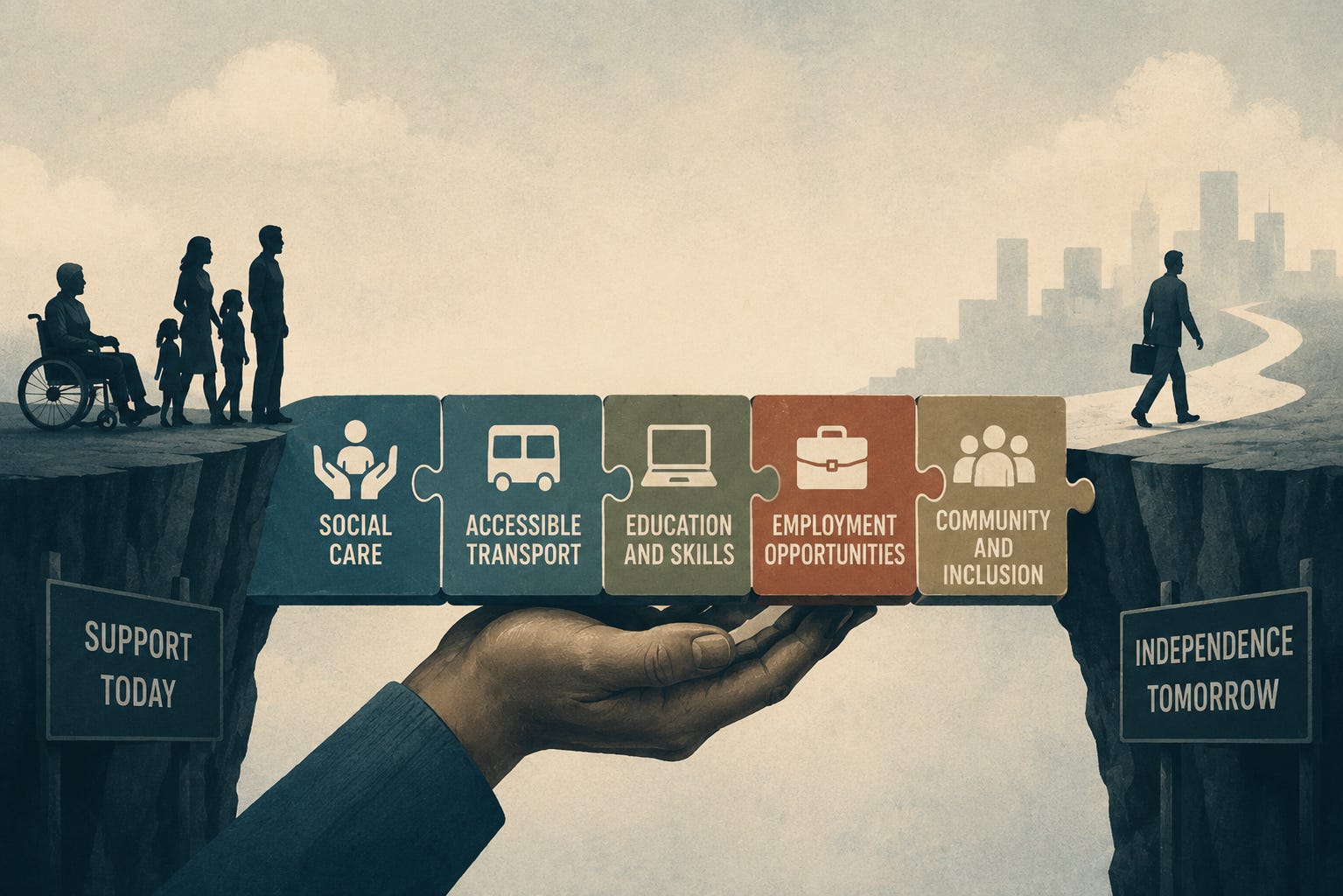
If employment is the destination, what is the bridge that enables people to get there?
For thousands of disabled people, that bridge is social care.
A care package is too often viewed as little more than assistance with washing, dressing, eating or taking medication. Those tasks are undeniably important, but reducing social care to a list of personal care activities fundamentally misunderstands its purpose.
The best social care does not simply keep people safe.
It enables people to live.
It allows someone to get out of bed early enough to travel to work. It provides the assistance needed to use public transport, attend university, volunteer, raise a family or start a business. It gives people the practical support that transforms aspiration into reality.
When politicians speak about increasing employment among disabled people, social care should not be treated as a separate policy area.
It is one of the conditions that makes employment possible.
This is where the debate about independence often becomes confused.
Britain has, for generations, celebrated the ideal of self-reliance. Independence is commonly understood as doing everything alone, asking for little and relying on no one.
For many disabled people, independence has never looked like that.
A wheelchair does not reduce independence.
A personal assistant does not reduce independence.
A care package does not reduce independence.
In countless cases, these are precisely the things that create it.
Independence is not the absence of support. It is having the freedom to make choices, pursue ambitions and participate in society on equal terms.
The distinction matters because public policy is shaped by the assumptions that underpin it.
If support is viewed primarily as a cost, governments will inevitably look for ways to reduce it.
If support is understood as an investment in human potential, very different decisions follow.
The economic argument is stronger than many realise.
When disabled people receive the right support, they are more likely to enter employment, remain in work and contribute through taxation. Families are often better able to continue working rather than leaving employment to provide unpaid care. Pressure on the NHS can be reduced through earlier intervention and greater stability in people’s lives.
The question is therefore not simply how much social care costs.
It is how much failing to provide it ultimately costs society.
There is another issue that deserves far greater attention.
Many disabled people speak of living with uncertainty. They worry that accepting more hours at work, changing jobs or improving their financial circumstances could affect the support they rely upon.
A system designed to encourage ambition should not create anxiety about success.
No one should feel they are being asked to choose between pursuing employment and keeping the practical assistance that enables them to remain employed.
That uncertainty risks becoming a barrier every bit as significant as physical inaccessibility.
The Timms Review also presents an opportunity to rethink how Britain measures disability itself.
Assessments, by their very nature, focus on what people struggle to do. They catalogue limitations because that is how entitlement is determined.
Yet a person cannot be reduced to an assessment form.
Behind every application is someone with relationships, talents, aspirations and the desire to contribute. Public policy should not stop at identifying barriers. It should also ask what becomes possible when those barriers are removed.
That requires a different philosophy.
One that moves beyond managing need and begins enabling opportunity.
One that sees care not simply as a service but as infrastructure for participation.
One that understands investment in disabled people is investment in Britain’s social and economic future.
The Government is right to ask how more disabled people can enter employment.
But employment policy cannot succeed in isolation.
It must sit alongside a social care system that is properly funded, flexible enough to adapt to changing lives and confident enough to place independence, rather than bureaucracy, at its heart.
The success of disability policy should not ultimately be judged by how many people leave the benefits system.
It should be judged by how many people are able to build meaningful lives, sustain employment, contribute to their communities and exercise genuine choice over their futures.
The Timms Review has opened an important debate.
The challenge now is ensuring Britain asks the right question.
Not simply how we reform the benefits system.
But how we build a society where the right support gives disabled people the freedom to live, work and thrive.
Because support is not the opposite of independence.
For millions of disabled people, it is the very foundation upon which independence is built.
The Government was approached for comment. No response was received before publication.