
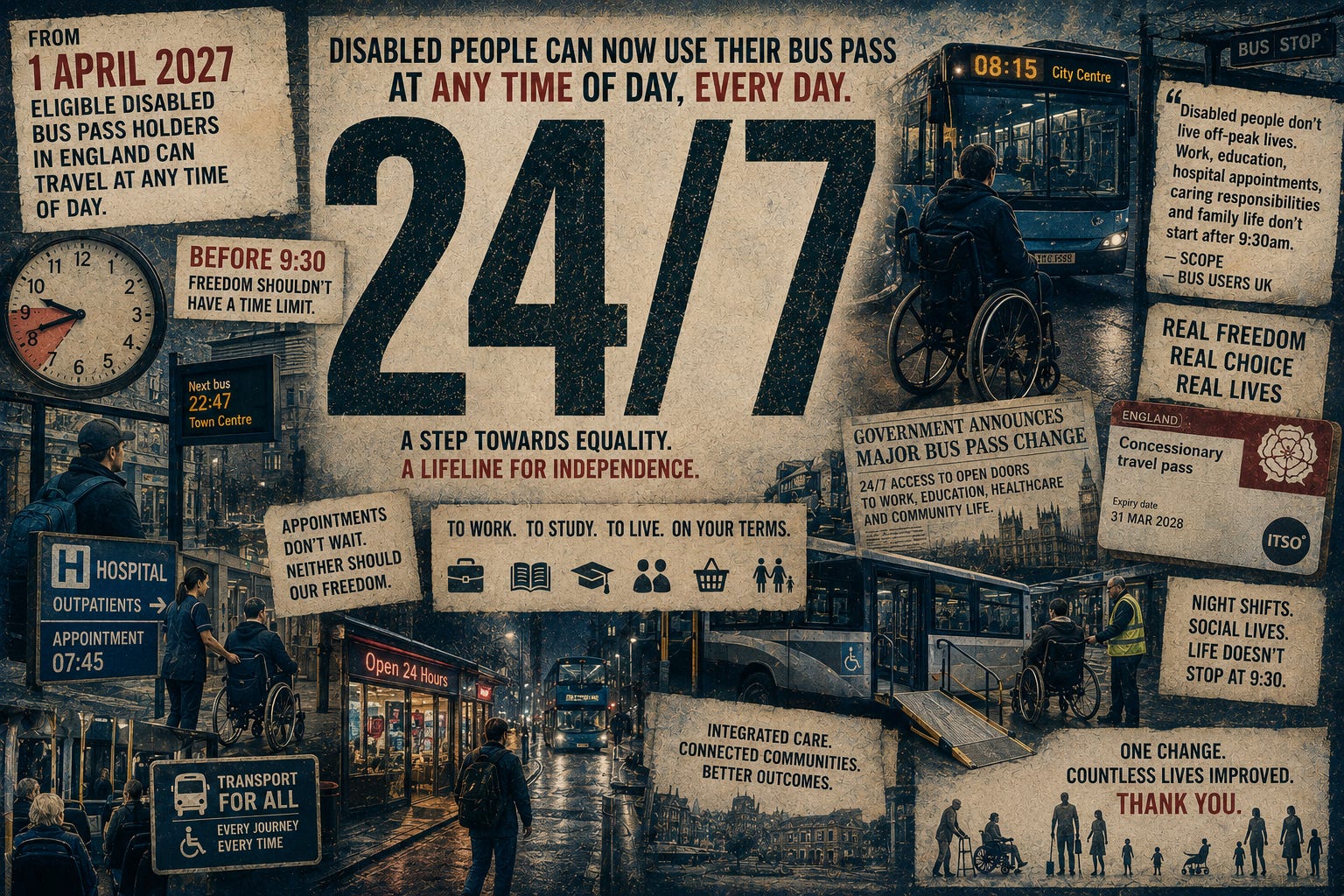
From 1st April 2027, people who hold a disabled bus pass can travel on buses for free, no matter the time of day. But what does that mean in reality?
What is the Disabled Bus Pass?
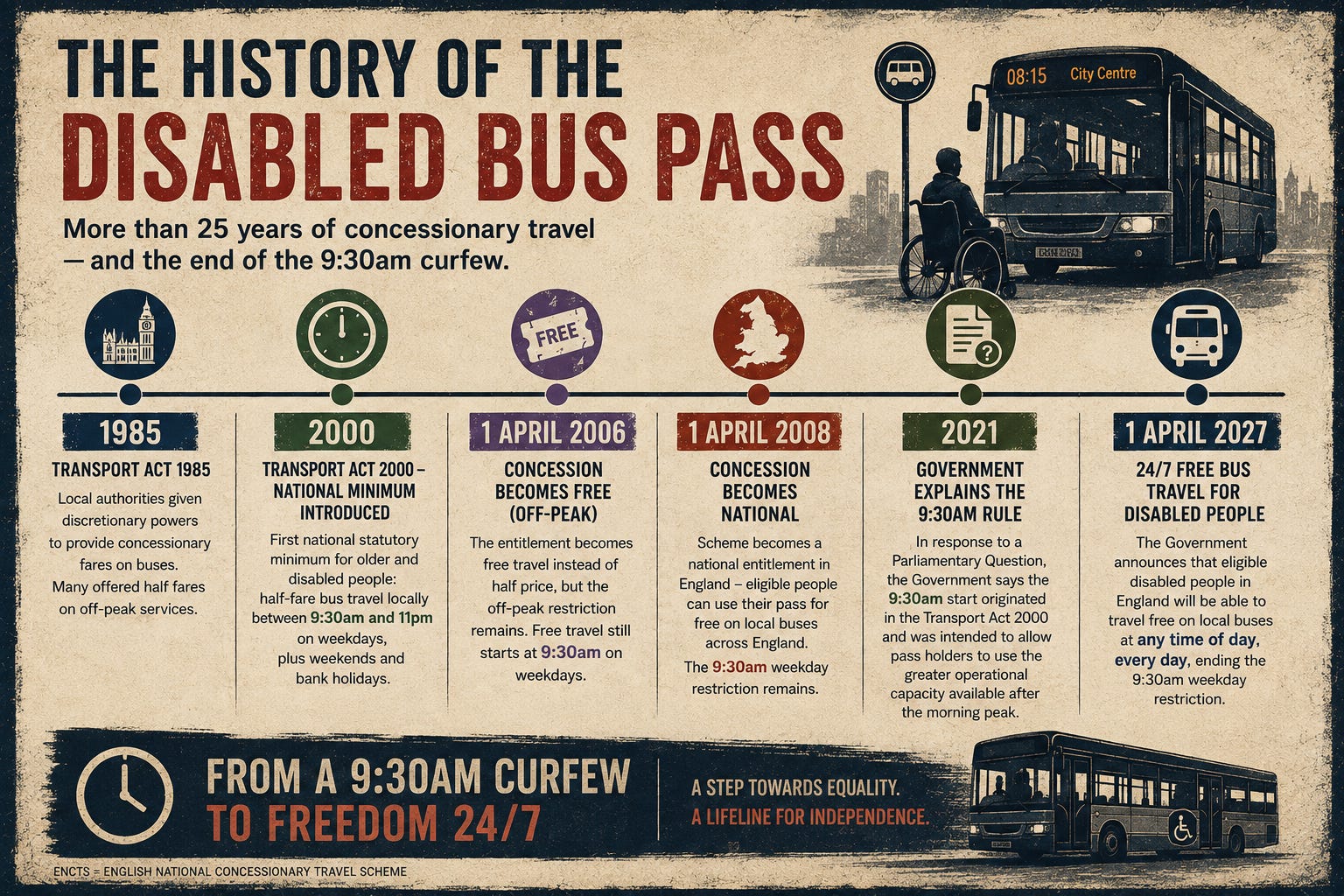
The disabled person’s bus pass gives eligible disabled people in England free travel on local buses under the English National Concessionary Travel Scheme. Under the current national rules, free weekday travel generally begins at 9:30am, although some councils already provide additional concessions.
The History
I think it is important to remember that 9:30am isn’t a recent restriction imposed on disabled people. It was built into the statutory national minimum from the beginning.
Under the Transport Act 1985, councils had discretionary powers to provide concessions, and many offered half fares on off-peak buses. The Transport Act 2000 then created the first national statutory minimum: eligible older and disabled people received half-fare bus travel locally between 9:30am and 11pm on weekdays, as well as on weekends and bank holidays.
Then, from 1 April 2006, the entitlement became free rather than half-price, but it remained off-peak, so the 9:30am restriction stayed. Finally, on 1st April 2008, the concession became national, allowing eligible people to use local buses throughout England, but again the 9:30am restriction remained.
In 2021, Baroness Hodgson asked the government specifically why disabled people’s bus passes were restricted before 9:30am and what assessment had been made of the impact on commuting to work.
The government’s answer was:
“The hours originated in the Transport Act 2000 and were intended to allow pass holders to use the greater operational capacity available after the morning peak.”
However, there is an important distinction between making a journey free and making that journey accessible. Removing the financial barrier before 9:30am may enable more disabled people to consider travelling to work, education or appointments during the morning peak, but it does not necessarily mean that they will be able to board the bus when it arrives.
Paulley v FirstGroup
On the morning of 24th February 2012, disability-rights campaigner Doug Paulley, who is a wheelchair user, arrived at Wetherby bus station at approximately 9:35am. He intended to catch a FirstGroup service to Leeds before continuing by train to Stalybridge, where he was due to meet his parents for lunch. The bus had a lowering platform, a wheelchair ramp and a designated wheelchair space. A notice in the space asked other passengers to give it up when it was required by a wheelchair user.
The timing of Paulley’s arrival is particularly striking in the context of the Government’s latest announcement. He arrived at approximately 9:35am, almost exactly when the statutory concessionary travel entitlement became available on a weekday. In other words, the clock was no longer an obstacle to his journey. What happened next demonstrated that accessibility could still be one.
When Paulley attempted to board, the designated wheelchair space was occupied by a woman travelling with a sleeping child in a pushchair. The driver asked her to move and fold the pushchair so that Paulley could use the space. She refused, explaining that the pushchair would not fold. The driver did not take the matter further, and Paulley was unable to board.
The consequences extended beyond simply having to wait for another bus. The service Paulley intended to use was scheduled to depart at around 9:36am, with subsequent buses at 9:56am and 10:36am. Paulley eventually travelled on a later service, but the delay meant that he missed his planned train from Leeds. He ultimately arrived at his destination approximately an hour later than intended.
The Court Case
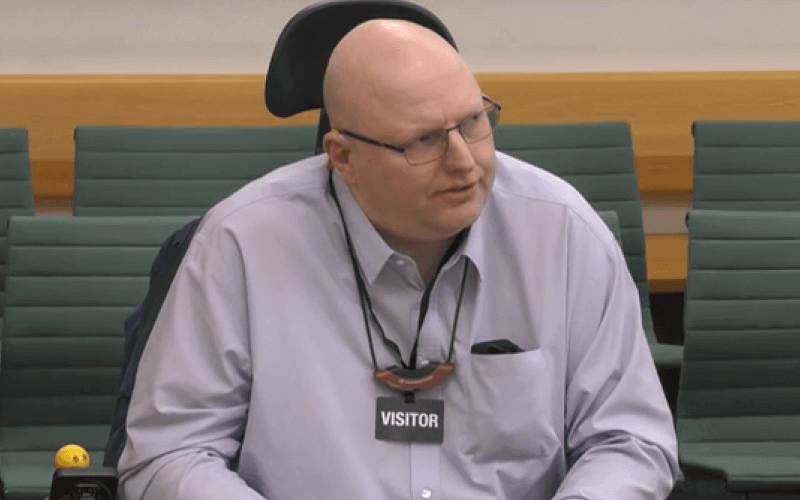
Paulley decided to challenge what had happened under the Equality Act 2010. His case was not simply about whether the woman with the pushchair should have moved. The much bigger legal question was what a bus operator should reasonably be expected to do to ensure that the designated wheelchair space is actually available to wheelchair users when they need it. As a service provider, FirstGroup was subject to duties under the Equality Act, including the duty to make reasonable adjustments where disabled people would otherwise experience a substantial disadvantage.
At the time, FirstGroup’s approach was essentially based on a request for cooperation. Its policy meant that a non-wheelchair user occupying the wheelchair space would be asked to move if a wheelchair user needed it. If that passenger refused, however, nothing necessarily happened further. The County Court considered that this placed Paulley and other wheelchair users at a substantial disadvantage compared with non-disabled passengers.
Paulley initially won. Recorder Isaacs, sitting at Leeds County Court, concluded that FirstGroup had failed to make reasonable adjustments. The court considered that the company’s policy should have gone further, including explicitly requiring non-disabled passengers to vacate the wheelchair space when needed and establishing an enforcement policy for cases where a passenger refused. Paulley was awarded £5,500 in damages.
FirstGroup appealed. The case went to the Court of Appeal, which unanimously overturned the County Court’s decision. The Court of Appeal considered that requiring drivers to compel passengers to vacate the space, potentially culminating in removing somebody from the bus, went too far. Lady Justice Arden said that if wheelchair users were to have an absolute entitlement to the space, stronger powers or duties were matters that Parliament could address.
Paulley did not leave the matter there. His case proceeded to the UK Supreme Court, where it was heard by seven justices in June 2016. Judgment was delivered on 18th January 2017 in FirstGroup Plc v Paulley. The Supreme Court unanimously allowed Paulley’s appeal, although the extent of his victory was more limited than the original County Court judgment. The Supreme Court did not establish an absolute right that would require any passenger occupying a wheelchair space to be removed from the bus. However, it found that FirstGroup’s policy did not go far enough. Simply asking a passenger to move and doing nothing further if they refused was not sufficient. Where a driver considered a refusal unreasonable, they should consider taking further steps to press the passenger to vacate the space, depending on the circumstances.
Paulley’s victory was therefore an important one, but it was not absolute. The Supreme Court did not restore the £5,500 damages awarded by the County Court because it could not be established that taking those additional steps would necessarily have persuaded the passenger to move on that particular journey. The case nevertheless established an important principle: providing a wheelchair space is not enough if the policies governing its use leave wheelchair users at a substantial disadvantage.
Why this matters in 2027
Starting 1st April 2027, eligible disabled passengers in England will no longer face the 9:30am weekday restriction. One reason for this change is that allowing unrestricted concessionary travel can help disabled individuals access employment more easily. Removing the restriction eliminates one obstacle, but Paulley’s experience highlights another: what if a passenger has the right to free travel but cannot board the bus?
For example, a wheelchair user who starts work at 9am has bus options at 7:45am, 8:15am, and 8:45am. Currently, their concession doesn’t cover free travel on these services, but from April 2027, it will. This could significantly reduce their travel costs. However, if the wheelchair space is unavailable on the 8:15am bus, they might have to wait for the 8:45am bus, risking arriving late. There’s no guarantee the wheelchair space will be free then either. If the next bus is 30 minutes away, a problem with one wheelchair space can cause an hour’s delay, disrupting their entire workday. It is precisely this connection between transport and employment that the Government has used to justify the change.
Work and Pensions Secretary Pat McFadden said:
“For too long, disabled people have held a free bus pass in their pocket that didn’t always get them to work. Now we’re changing that. By removing these time restrictions, we’re helping disabled people access jobs, training, and other opportunities at any time of the day.
Alongside our £3.5 billion investment in tailored employment support, this change shows we’re serious about breaking down the barriers that have held disabled people back for too long.”
There is an irony here. In 2021, the Government’s explanation for the 9:30am restriction was that it allowed concessionary passengers to travel when there was greater operational capacity after the morning peak. Six years later, government policy will actively encourage disabled passengers to travel during that very peak.
If removing the restriction is intended to help disabled people get into work, the question therefore cannot simply be whether their bus pass works at 8am. It must also be whether the transport system can reliably accommodate them at 8am. For wheelchair users in particular, that raises questions about the availability of wheelchair spaces, the frequency of services and what happens when the only available space is already occupied. If missing one bus means waiting another 30 minutes, with no guarantee that the wheelchair space on the next bus will be available, free travel does not necessarily translate into reliable travel.
Doug Paulley’s experience demonstrated that more than a decade ago. He arrived at Wetherby bus station at approximately 9:35am. The clock was not preventing him from travelling. The bus was. From April 2027, the clock will no longer prevent disabled concessionary pass holders from travelling before 9:30am either.
The question now is whether the buses will be ready for them.